
If you’ve received a message that simply says OTW, you may have paused for a second and wondered what it means. In today’s fast-moving digital world, abbreviations have become a major part of online communication. Whether you’re chatting with friends, texting family members, or sending quick updates to coworkers, short forms help people communicate faster and more efficiently.
Among the many texting abbreviations used every day, OTW is one of the most common. You can spot it in text messages, social media conversations, online gaming chats, workplace messages, and even email conversations.
Understanding modern internet slang is important because it helps you avoid confusion and respond appropriately. While some abbreviations can have multiple meanings, OTW has a straightforward interpretation in most situations.
In this detailed guide, you’ll learn exactly what OTW means in text, where it came from, how people use it, common examples, variations, and tips for using it naturally in conversations.
What Does OTW Mean in Text?
OTW stands for “On The Way.”
People use this abbreviation when they want to tell someone they are currently traveling toward a destination or heading somewhere.
It is a quick and convenient way to let others know that they are moving and will arrive soon.
Example:
Friend: Are you coming?
You: OTW! 🚗
In this example, “OTW” means the person is already heading to the location.
Quick Definition Table
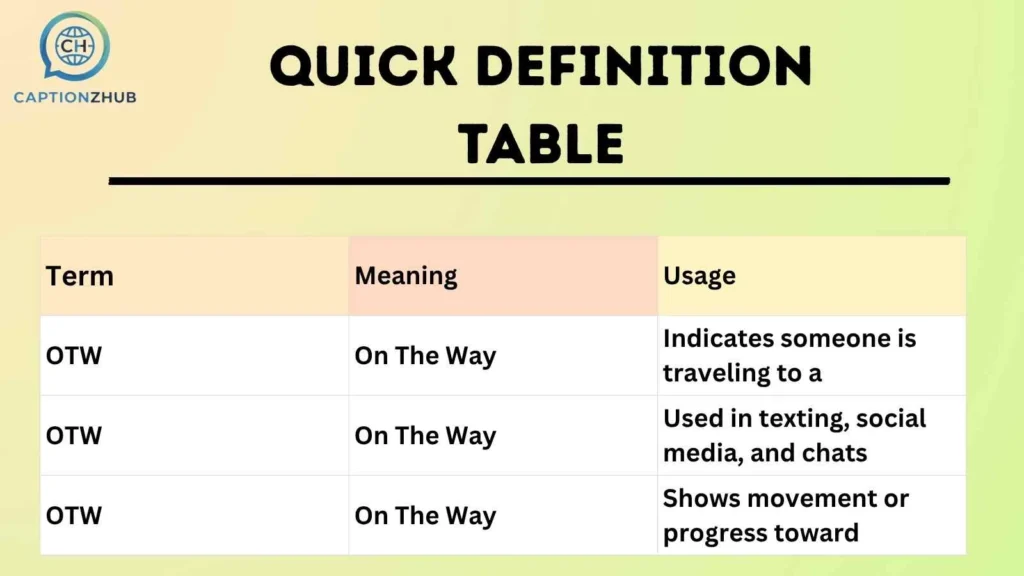
| Term | Meaning | Usage |
|---|---|---|
| OTW | On The Way | Indicates someone is traveling to a destination |
| OTW | On The Way | Used in texting, social media, and chats |
| OTW | On The Way | Shows movement or progress toward something |
How OTW Is Used in Everyday Conversations
The abbreviation OTW is popular because it saves time. Instead of typing an entire sentence, users can communicate the same idea with only three letters.
People commonly use OTW when:
- Heading to a friend’s house
- Traveling to work
- Going to a meeting
- Picking someone up
- Attending an event
- Meeting for lunch or dinner
- Joining an online gaming session
Because texting often happens while people are busy, OTW provides a fast update without requiring a lengthy explanation.
Examples of OTW in Text Messages
Here are some common examples showing how OTW appears in real conversations.
Example 1: Meeting Friends
Sarah: We’re all here. Where are you?
Jake: OTW. I’ll be there in 10 minutes.
Example 2: Family Conversation
Mom: Did you leave work yet?
Daughter: Yes, OTW now.
Example 3: Event Planning
Friend: The movie starts soon.
You: OTW 🚘
Example 4: Pickup Situation
Brother: Can you pick me up?
You: OTW.
As you can see, OTW fits naturally into many everyday situations.
The Origin of OTW
The phrase “On The Way” has existed for centuries in everyday English. However, the abbreviated form OTW became popular with the rise of mobile phones, instant messaging, and internet communication.
During the early days of SMS messaging, users often had character limits. As a result, people started shortening common phrases into abbreviations.
Over time, internet culture embraced these shortened expressions. Similar abbreviations such as LOL, BRB, IMO, IDK, and TBH gained popularity, and OTW became part of the same trend.
Today, OTW is recognized globally and is understood by millions of internet users.
OTW Meaning on Social Media
Social media users frequently use OTW when posting updates about their activities.
You’ll often see captions such as:
- OTW to the airport ✈️
- OTW to my dream vacation 🌴
- OTW to the gym 💪
- OTW to success 🚀
- OTW to the concert 🎵
Interestingly, social media users sometimes use OTW both literally and figuratively.
Literal: Traveling somewhere physically.
Figurative: Making progress toward a goal or achievement.
For example:
Finished another course today. OTW to becoming a software developer! 🚀
In this case, the person isn’t physically traveling. Instead, they are moving toward a personal goal.
OTW Meaning in Online Gaming
Gamers also use OTW frequently during multiplayer matches.
In gaming, OTW usually means a player is coming to assist teammates or moving toward a specific location on the map.
Examples include:
- OTW to your location.
- OTW for backup.
- Enemy spotted, OTW.
- OTW to objective.
Because gaming often requires quick communication, abbreviations like OTW help players coordinate efficiently.
Can OTW Have Other Meanings?
Although On The Way is by far the most common meaning, OTW can occasionally represent different phrases depending on context.
| OTW Meaning | Context |
|---|---|
| On The Way | Texting and social media |
| Off The Wall | Informal slang discussions |
| Over The Weekend | Business communication |
| On The Web | Technology discussions |
However, when someone sends OTW in a regular text message, there is an overwhelming chance they simply mean On The Way.
Why OTW Remains Popular in 2026
Many internet abbreviations come and go. However, OTW continues to remain relevant because it solves a common communication need.
- It’s short and easy to type.
- It saves time.
- It is widely understood.
- It works across multiple platforms.
- It fits both personal and professional conversations.
- It communicates status instantly.
These advantages ensure that OTW remains one of the most frequently used texting abbreviations today.
OTW vs Other Popular Texting Abbreviations
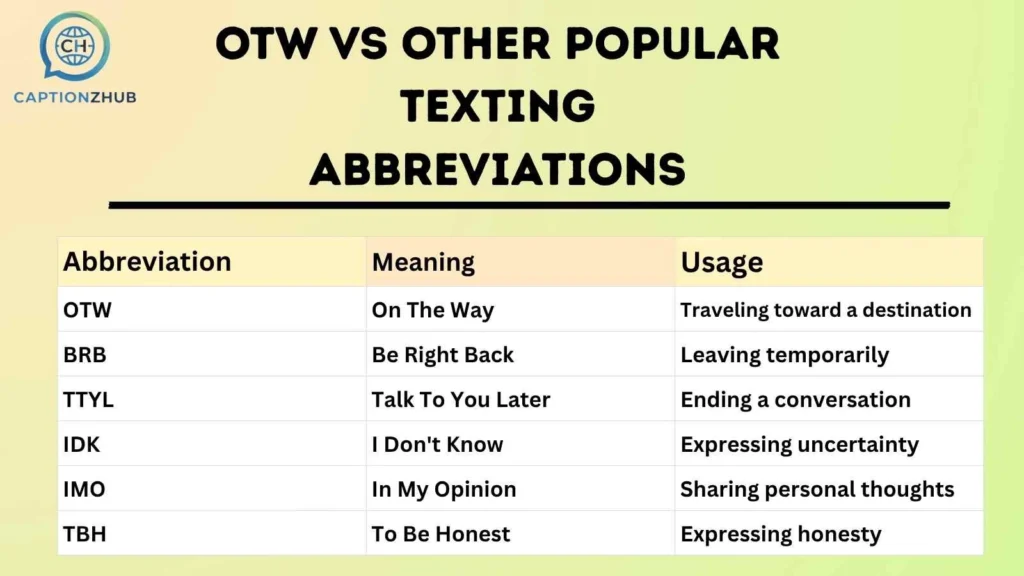
Many people confuse OTW with other texting shortcuts because modern messaging contains hundreds of abbreviations. Understanding the differences helps you communicate more clearly.
| Abbreviation | Meaning | Usage |
|---|---|---|
| OTW | On The Way | Traveling toward a destination |
| BRB | Be Right Back | Leaving temporarily |
| TTYL | Talk To You Later | Ending a conversation |
| IDK | I Don’t Know | Expressing uncertainty |
| IMO | In My Opinion | Sharing personal thoughts |
| TBH | To Be Honest | Expressing honesty |
Unlike many internet abbreviations that express emotions or opinions, OTW specifically communicates movement, progress, or arrival status.
When Should You Use OTW?
OTW works best when you need to provide a quick update about your location, arrival time, or progress toward a goal.
Common situations include:
- Meeting friends for coffee ☕
- Heading to school or college 🎓
- Driving to work 🚗
- Attending a family gathering 👨👩👧👦
- Going to a party 🎉
- Joining an online gaming team 🎮
- Traveling to an appointment 📅
- Picking someone up 🚕
In each case, OTW provides a fast status update without requiring a long explanation.
When You Should Avoid Using OTW
Although OTW is extremely common, there are situations where using the full phrase “On The Way” may be more appropriate.
Consider avoiding OTW when:
- Writing formal business reports
- Communicating with clients who may not understand internet slang
- Submitting academic assignments
- Writing legal documents
- Creating professional presentations
In professional environments, clarity should always come before convenience.
For example:
Professional: I am on the way to the meeting and expect to arrive at 2:00 PM.
This sentence sounds more polished than simply writing “OTW.”
OTW in Professional Communication
The workplace has become increasingly digital. As a result, many professionals now use texting abbreviations in internal chats and messaging platforms.
In casual workplace communication, OTW is generally acceptable.
Examples include:
OTW to the office.
OTW to the client meeting.
Presentation materials are OTW.
However, understanding your company culture is important. Some organizations encourage casual communication, while others prefer formal language.
A useful rule is to match the communication style of your team.
OTW as a Figurative Expression
One reason OTW remains popular is its flexibility. It does not always refer to physical travel.
People often use it metaphorically to describe progress toward goals, achievements, or milestones.
Examples include:
- OTW to graduation 🎓
- OTW to financial freedom 💰
- OTW to my fitness goals 💪
- OTW to 1 million followers 📈
- OTW to becoming a homeowner 🏡
In these examples, the speaker is not literally traveling. Instead, they are progressing toward an objective.
How Different Generations Use OTW
The popularity of OTW spans multiple generations, although usage styles can vary.
Gen Z
Gen Z frequently uses OTW in texting, social media captions, and group chats. They often combine it with emojis and trending slang.
Example:
OTW bestie 🚗✨
Millennials
Millennials commonly use OTW for practical communication, especially regarding meetings, travel, and social plans.
Example:
Running a few minutes late, OTW now.
Older Adults
Many older adults understand OTW because it has existed for years. However, some still prefer writing the full phrase.
Common Mistakes People Make With OTW
Even simple abbreviations can be misunderstood. Here are some common mistakes to avoid.
Mistake #1: Using OTW Too Early
If you have not actually left yet, saying OTW may create confusion.
Incorrect:
OTW.
Reality: Still getting dressed.
Correct:
Leaving in 5 minutes.
Mistake #2: Assuming Everyone Knows the Meaning
Not everyone is familiar with internet slang. Consider your audience before using abbreviations.
Mistake #3: Using OTW in Highly Formal Documents
Formal writing generally requires complete words and sentences.
Popular Variations Related to OTW
Internet users often combine OTW with additional words or symbols.
- OTW Home 🏠
- OTW Back
- OTW Now
- OTW There
- OTW Soon
- OTW 🚗
- OTW ✈️
- OTW 🚀
These variations provide extra context while keeping the message concise.
Sample Conversations Using OTW
Friends Meeting Up
Emma: Are you coming?
Noah: OTW. See you in 15!
Family Gathering
Dad: Dinner is ready.
Son: OTW home.
Work Meeting
Manager: Will you make the meeting?
Employee: OTW. Traffic is light.
Gaming Session
Player 1: Need backup!
Player 2: OTW.
These examples demonstrate how naturally OTW fits into modern communication.
Why Abbreviations Like OTW Matter in Digital Communication
Texting culture continues to evolve. Every year, new slang terms appear while others disappear. OTW has survived because it provides genuine value.
Benefits include:
- Faster communication
- Reduced typing effort
- Instant understanding
- Convenient mobile messaging
- Universal recognition
- Improved conversational flow
As messaging platforms continue growing, practical abbreviations such as OTW will likely remain part of everyday language.
OTW Meaning at a Glance
| Question | Answer |
|---|---|
| What does OTW mean? | On The Way |
| Where is it used? | Texts, social media, chats, gaming, workplace messages |
| Is it formal? | Usually informal |
| Can it be figurative? | Yes, it can indicate progress toward goals |
| Is it popular in 2026? | Yes, it remains widely used worldwide |
Expert Tips for Using OTW Naturally
Although OTW is simple, using it naturally can make your messages feel more conversational and clear. The key is understanding the context and audience.
Here are a few expert tips:
- Use OTW only when you are actually heading somewhere.
- Add an estimated arrival time when possible.
- Use emojis to make casual messages more engaging. 🚗✨
- Avoid using OTW in highly formal business documents.
- Consider your audience’s familiarity with texting abbreviations.
- Provide additional details if timing is important.
For example, instead of simply writing “OTW,” you could write:
OTW now. Should be there in 10 minutes. 🚗
This gives the recipient more useful information while keeping the message brief.
Examples of OTW on Different Platforms
Text Messages
Friend: Where are you?
You: OTW!
Instagram Caption
OTW to a new adventure ✈️🌍
X (Twitter) Post
OTW to the biggest event of the year!
Facebook Status
Coffee in hand and OTW to work. ☕🚗
Gaming Chat
Need support? OTW!
These examples show how versatile the abbreviation has become across digital platforms.
OTW vs On My Way (OMW)
Another abbreviation often compared with OTW is OMW, which stands for On My Way.
| Abbreviation | Meaning | Difference |
|---|---|---|
| OTW | On The Way | General statement |
| OMW | On My Way | Specifically refers to the sender |
Examples:
OTW to the office.
OMW to your house.
In everyday texting, many people use them interchangeably. However, OMW is slightly more personal because it directly refers to the sender.
What Does OTW Mean in Text?
OTW means “On The Way.” It is a popular texting abbreviation used to indicate that someone is currently traveling toward a destination or making progress toward a goal. OTW is commonly used in text messages, social media posts, online chats, gaming conversations, and workplace messaging.
FAQs:
1. What does OTW mean in texting?
OTW stands for On The Way. It tells someone that you are heading toward a destination or making progress toward something.
2. Is OTW considered slang?
Yes. OTW is a form of internet and texting slang. However, it is widely understood and commonly used in everyday communication.
3. Can OTW be used professionally?
Yes, in casual workplace chats and messaging platforms. However, formal emails and reports typically require the full phrase “On The Way.”
4. What is the difference between OTW and OMW?
OTW means “On The Way,” while OMW means “On My Way.” OMW specifically refers to the sender, whereas OTW can be used more generally.
5. Does OTW always mean traveling somewhere?
No. OTW can also be used figuratively to show progress toward a goal, achievement, or milestone.
Final Thoughts:
Understanding what OTW means in text helps you navigate modern digital communication with confidence. While countless abbreviations exist online, OTW remains one of the most useful and universally recognized.
In most situations, OTW simply means “On The Way.” Whether you’re heading to a friend’s house, traveling to work, joining an online game, or moving toward a personal goal, OTW provides a quick and effective way to communicate progress.
Its simplicity, versatility, and widespread recognition have helped it remain popular across text messages, social media platforms, gaming communities, and workplace chats. As digital communication continues evolving, OTW is likely to remain a valuable part of online language for years to come.

Ali Morshedlou is the creative voice behind Captionzhub, turning simple words into fun and relatable content. Known for a natural sense of humor, the writing feels easy, human, and engaging.